
Bones with many splinters and not cut cleanly
Too much fat for a leg
Not all stuff as on photos
 Media gallery
 Media gallery
 Media gallery
Couldn't load pickup availability


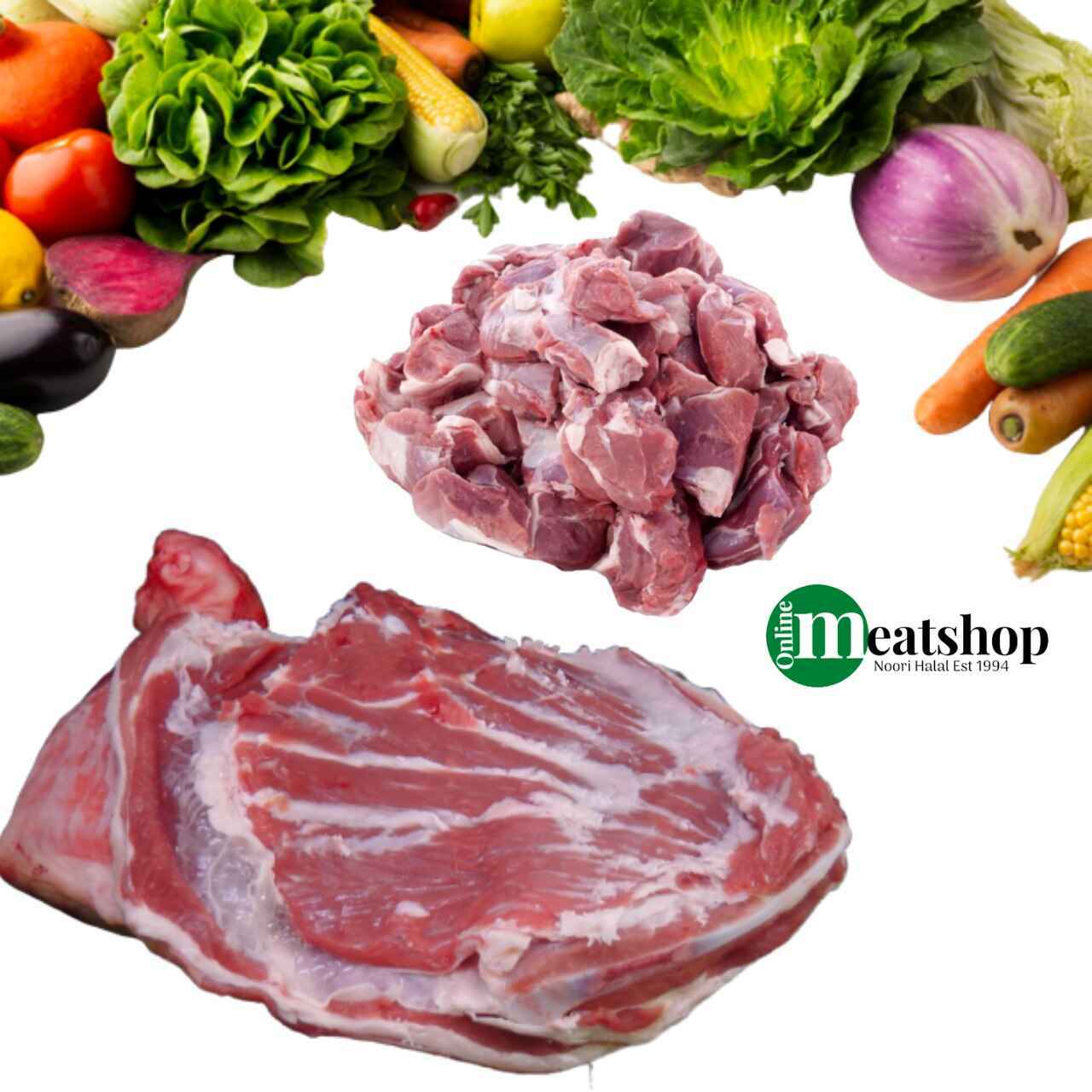

This whole mutton shoulder is 100% mutton — Certified Halal, British, from animals slaughtered by the non-stunned method, Antibiotic-free and Growth hormone-free. Sold whole, it's also cut to order into steaks, diced pieces or chunks, Fat-On or Fat-Off. Packs run 500g up to 4kg, suited to slow braises, roasts and rich yakhni-style curries.
Shoulder has more connective tissue and fat than leg, so it rewards a long, moist cook rather than a quick roast. Packed from 500g to 4kg, this whole shoulder scales from a small braise to a family-sized yakhni pot in one order.
Leg is usually carved in slices; shoulder, by contrast, is built to be cut to order — steaks, diced pieces or chunks, Fat-On or Fat-Off — so the same piece works for curry, stew or a slow roast.
You can have the whole shoulder cut to order as steaks (150-180g) for grilling, or diced in three sizes — 10-15g for quick-cooking curries, 25-30g for everyday curry, or 50-60g for slower stews — plus chunks (160-180g) for kebabs and one-pot dishes. Choose Fat-On for extra richness or Fat-Off if you prefer it leaner.
Packs run 500g, 1kg, 2kg or 4kg, so one cut scales from a midweek curry for two up to a full table's worth of yakhni.
Once it arrives, keep the shoulder refrigerated and use it within a couple of days, or freeze it the day it arrives.
Give it around 12 hours to defrost fully before cutting or cooking — the fridge works better here than room temperature.
This whole shoulder comes packed in 500g, 1kg, 2kg or 4kg sizes.
Go for a 500g or 1kg pack for a curry serving two to three, or pick up a 2kg or 4kg pack for a family yakhni pot or a shared roast.
Once it arrives, keep the shoulder refrigerated and use it within a couple of days, or freeze it the day it arrives.
Give it around 12 hours to defrost fully before cooking, and use the fridge rather than room temperature if you can.
Typical values per 100 g (raw):
| Energy | 716 kJ / 171 kcal (converted at 4.184 kJ per kcal) |
|---|---|
| Protein | 20 g |
| Fat | 10.2 g |
Basis: untrimmed mutton shoulder, diced or in strips - "Mutton, boneless dice or strips, shoulder, untrimmed, raw" (recipe-calculated from analysed components, not directly analysed). Reference: Australian Food Composition Database, Release 3.0, Food Standards Australia New Zealand (FSANZ), Public Food Key F005983. Based on Australian data.
Brown the diced shoulder (25-30g) in a heavy pot, then let it simmer low in a light, aromatic broth until the meat falls apart easily.
Rub the whole shoulder Fat-On, cover it, and roast low and slow until the meat turns fork-tender and shreds on its own.
Give the 150-180g steaks a short marinade, then sear them hot and fast, and rest before you serve them with flatbread.
Yakhni mutton curry starts here — the diced shoulder simmered slowly in a light, spiced broth.
Mutton karahi and bhuna also work well, using the 25-30g or 50-60g diced sizes for a rich, restaurant-style gravy.
Try slow-braised shoulder for pulled mutton wraps, or roast the whole shoulder as a shared centrepiece.
Given its size and the connective tissue running through it, expect long, slow cooking — typically several hours at a low oven temperature until the meat turns fork-tender.
Keep it covered for most of the cooking time so the shoulder stays moist, then uncover it for the final stretch so the outside can firm up.
It should shred easily under light pressure from a fork. If it still resists, give it more time at a low, steady heat.
Yes — packs range from 500g to 4kg, and a larger piece needs proportionally longer in the oven, so weigh what you're cooking and scale the time accordingly.