
Skip to product information
-
 Media gallery
-
 Media gallery
-
 Media gallery
-
 Media gallery


Vendor:
Onlinemeatshop
Fresh Halal British Diced Chicken Breast Boneless & Skinless
- Regular price
- £16.32
- Regular price
-
£16.49 - Sale price
- £16.32
- Unit price
- per
Couldn't load pickup availability


Notified by email when this product becomes available

Fresh Halal British Diced Chicken Breast Boneless & Skinless
You may also like
- Description
- Serving Guide
- Storage Handling
- Nutritional Info
- Recipe Ideas
- Dishes
- Product FAQs
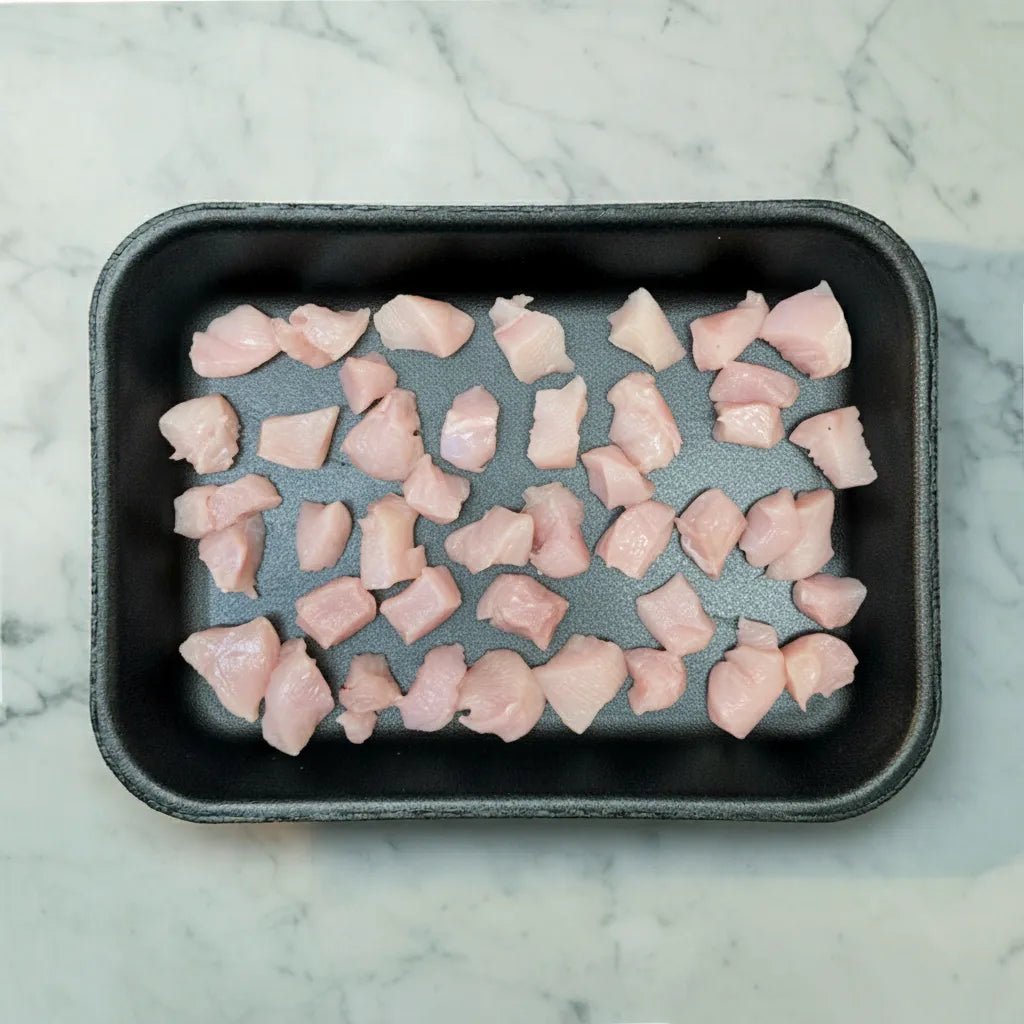
Ask your butcher for diced chicken breast and this is what turns up: boneless, skinless breast fillet, already cubed so curry, tikka and stir-fry need no board work at home. This Certified Halal chicken comes cut anywhere from 40-50g tikka chunks down to 5-10g dice, packed from 250g up to 2kg.
Is diced breast just a fillet cut small?
Yes — it's the same boneless, skinless fillet you'd find sold whole, just taken further with the knife. Here it's cut down to 40-50g tikka chunks or as fine as 5-10g dice, so what changes is the size, not the cut itself. That's the board work already done before the curry or skewer starts.
How the cubes and packs break down
- Large Cubes - Tikka/Sheesh, 40-50g
- Medium Cut - Curry/Rice, 30-35g
- Small Cut, 15-20g
- Very Small Cut - Chinna/Pasta Cut, 5-10g
Packs run 250g to 2kg — small enough for one tray, large enough to batch-cook and freeze in portions.
Keeping it once it's home
Diced chicken breast keeps in the freezer for up to 3 months — freeze it on the day it arrives if you're not cooking straightaway. The small pieces defrost quicker than a whole fillet, so check they're fully thawed before they meet a marinade.
A 250g pack covers one or two curry portions, or a handful of tikka skewers.
Go up to 500g or 1kg for a family meal, or reach for the 2kg pack if you're batch-cooking a curry to freeze in portions.
Once it's home, diced chicken breast stays chilled until its use-by date, or into the freezer for up to 3 months.
Spread the small pieces out on a plate to defrost instead of thawing them as one block — their surface area means they come up to temperature faster than a whole fillet.
Typical values per 100 g (raw):
| Energy | 120 kcal |
|---|---|
| Protein | 22.50 g |
| Fat | 2.62 g |
Basis: skinless boneless chicken breast, meat only. Reference: USDA FoodData Central, "Chicken, broiler or fryers, breast, skinless, boneless, meat only, raw" (FDC 171077).
Tikka skewers: thread the 40-50g cubes and grill or pan-sear them until the edges char.
Quick curry: brown the 30-35g dice in a hot pan first, then let it finish in the sauce rather than stew from raw.
Pasta or rice bake: fold the 5-10g dice through so it cooks through at the same rate as everything else in the pan.
Chicken tikka: the 40-50g cubes are the right size for skewers and a quick, high-heat char.
Chicken karahi: the 30-35g dice holds together through a fast, high-heat karahi cook.
Biryani: the 15-20g and 5-10g cuts go straight into the rice, no extra cutting needed.
Should I oil the chicken or the pan?
Oil the pan lightly rather than drowning the dice in oil first — the pieces are small, down to 5-10g, and too much oil poured straight over them just makes the pan spit.
Does the cube size change how much oil it needs?
The smaller 5-10g dice for pasta or rice barely needs a coating since it cooks so fast, while the larger 40-50g tikka chunks are better for a light oiling before they go on a skewer.
Will it stick if I skip the oil?
A hot, lightly oiled pan is usually enough — the pieces are already cut small, so they release moisture quickly, and a dry pan is more likely to cause sticking than too little oil ever is.
Do I need to oil the chicken for a curry?
Not directly — for the curry-cut 30-35g dice, oiling the pan or the base ingredients before the chicken goes in gives a better sear than oiling the meat itself.