



Non-stunned Halal
Sourced from sustainable UK farms
Temperature-controlled Woolcool packaging
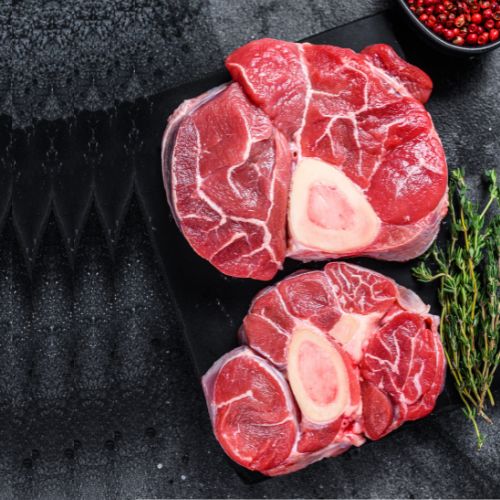
Beef shin bone-in is the lower foreleg cut from the shank, sold on the bone with its marrow intact — the same cut behind osso buco. This is Certified Halal beef, slaughtered by the non-stunned method, cut as steaks, dice or chunks for long, moist cooking.
How is beef shin bone-in cut?
It's cut to order: bone-in steaks at 225-250g or 450-500g, diced osso buco at 10-15g, 25-30g or 50-60g, and chunks at 160-180g, packed from 500g up to 4kg.
How do you cook bone-in beef shin?
Shin needs low, slow, wet heat: braise the bone-in steaks or simmer the diced osso buco into nihari until the meat falls from the bone. If it's frozen, give it about 12 hours in the fridge to defrost before it goes into the pot.
Butcher's tip: keep it at a gentle simmer, not a rolling boil, so the connective tissue melts instead of toughening.
Is beef shin the same as shank?
Yes — shin and shank name the same lower-leg cut in beef; British butchers say 'shin', lamb butchers say 'shank'. It's sold bone-in, from 500g up to 4kg.
Questions about cooking bone-in beef shin
Is bone-in beef shin cooked covered or uncovered?
Cover it — the lid keeps the shin moist through its long braise. Take it off near the end so the sauce can reduce and thicken.
Beef shin bone-in comes by the pack rather than a fixed piece count, so order by portions: a 500g pack suits one or two people for a stew or curry, a 1kg or 2kg pack covers a family meal, and the 4kg pack gives you enough bone-in shin for a big batch of nihari or a freezer-stock order.
Give frozen beef shin about 12 hours in the fridge to defrost before it goes into the pot. Once thawed, keep it refrigerated and cook it promptly rather than refreezing it raw.
Typical values per 100 g (raw):
| Energy | 147 kcal |
|---|---|
| Protein | 20.61 g |
| Fat | 7.20 g |
Basis: New Zealand beef hind shin, lean and fat together, published without a trim specification. Reference: USDA FoodData Central, "Beef, New Zealand, imported, hind shin, separable lean and fat, raw" (FDC 173105).
Bone-in beef shin shines in slow-cooked dishes — it's the classic base for nihari, the Pakistani shank curry simmered until the meat shreds off the bone, and for Italian osso buco, where the marrow-filled bone is the whole point. The same diced shin makes a rich yakhni stock or a British-style beef stew too.
- Nihari-style curry: simmer the diced osso buco low and slow with warming spices until it falls off the bone.
- Osso buco braise: brown the bone-in steaks, then braise them in stock and tomatoes until the marrow turns spoonable.
- Pressure-cooked stew: cook the diced shin with root vegetables for a faster, rich stock-based stew.
Should you cook bone-in beef shin covered or uncovered?
Cover it. A lid traps the moisture so the bone-in steaks or diced osso buco braise gently instead of drying out over the long, slow cook.
What happens if you leave it uncovered the whole time?
The liquid reduces too fast and the surface can dry out and toughen before the shin has had time to soften, so keep a lid on for most of the cook.
Is it ever okay to take the lid off?
Yes — near the end, once the meat is tender and pulling from the bone, uncover it for the last stretch so the sauce can reduce and thicken.
Does the covered rule change between the bone-in steaks and the diced osso buco?
No — both want the same covered, low, slow treatment; the diced osso buco pieces will just be ready sooner than the larger bone-in steaks.